The 2026 Hyundai Ioniq 9 Arrives as a Genuine Family Electric SUV
The 2026 Hyundai Ioniq 9 represents a meaningful shift in how electric vehicle manufacturers approach the family market. Unlike many early EV offerings designed primarily for commuters or enthusiasts, this three-row electric SUV prioritizes everyday practicality, spacious seating, and real-world usability that resonates with parents and multi-passenger households. Recent firsthand testing confirms that Hyundai has engineered a vehicle that balances electric propulsion efficiency with the interior flexibility and comfort standards that families actually need. This positions the Ioniq 9 as a serious competitor in the growing segment of affordable three-row electric vehicles designed for American households.
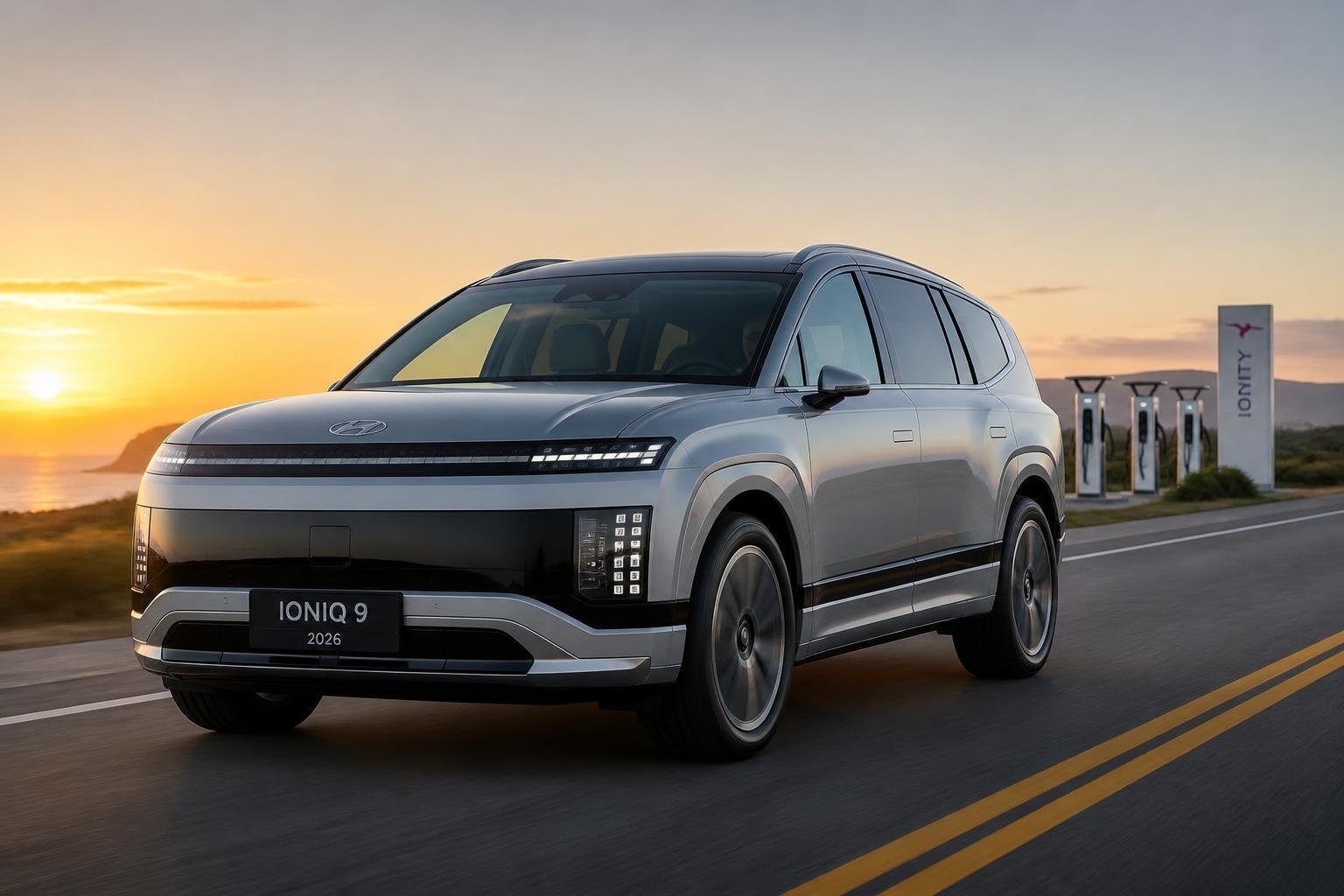
The significance of the Ioniq 9’s arrival extends beyond its individual features. It signals a maturing EV market where manufacturers are no longer treating electric family vehicles as niche products but as core offerings in their lineups. For families researching electric SUVs, this vehicle introduces a fresh set of practical options and performance benchmarks that differ notably from sedan-based electric vehicles. The timing also aligns with expanding EV infrastructure and government incentive programs that are making electric vehicle ownership more accessible across income levels and household sizes.
What Happened: Hyundai’s Three-Row Electric SUV Goes on the Market
The 2026 Hyundai Ioniq 9 has entered the American market as a production-ready three-row electric SUV. Recent evaluations by automotive journalists who drove the vehicle confirm that it delivers on its family-focused design promise. The testing covered real-world driving scenarios, seating comfort, cargo utility, climate control performance, and daily usability—the criteria that matter most to families considering the switch to electric.
Hyundai built the Ioniq 9 from the ground up as an electric vehicle rather than converting an existing gas-powered platform. This approach allowed engineers to maximize interior space, optimize battery placement for low center of gravity, and design a chassis that takes full advantage of electric propulsion characteristics. The three-row configuration provides seating for up to seven passengers, addressing one of the primary barriers that has kept families away from earlier EV options that lacked room for larger households.
The vehicle’s arrival comes as U.S. EV infrastructure continues rapid expansion. Retailers are now deploying charging networks at their facilities, while state-level incentive programs are evolving to encourage broader EV adoption. These complementary infrastructure improvements make the timing favorable for families willing to transition to electric power.
Key Specs and Features at a Glance
The 2026 Hyundai Ioniq 9 brings several critical capabilities that address standard family concerns:
- Three-row seating configuration accommodating up to seven passengers with flexible interior layouts
- Electric-only drivetrain with no hybrid or gas backup engine
- Real-world range sufficient for daily family driving and weekend trips
- Level 2 and DC fast-charging compatibility for home and public charging networks
- Thermal management system designed to maintain battery and cabin performance in varied climates
- Standard safety systems including collision avoidance, blind-spot detection, and electronic stability control
- Spacious cargo area with configurable seating to accommodate gear for larger families and recreational activities
Background: The Evolution of Family Electric Vehicles in the U.S. Market
The American EV market has historically favored compact sedans and smaller crossovers, partly because early electric technology focused on maximizing range with lighter vehicle designs. Families seeking three-row seating had limited options: expensive luxury EVs, upcoming vehicles still in development, or alternatively continuing with traditional gas-powered SUVs. This gap created a genuine market need that manufacturers are now addressing as battery technology improves and production scales expand.
Hyundai, as part of the Hyundai-Kia automotive group, has made electric vehicles a strategic priority. The company launched the Ioniq brand specifically to house its electric and electrified models, signaling long-term commitment to EV market segments. The Ioniq 9 represents the flagship of this strategy for families and larger households. Previous Ioniq models established the brand’s reputation for balancing efficiency, affordability, and design, and the Ioniq 9 extends these principles to the three-row SUV category.
Battery technology advancement has made three-row electric SUVs feasible without unacceptable range penalties. Modern lithium-ion batteries deliver sufficient energy density to power larger vehicles across meaningful daily distances. Simultaneously, public DC fast-charging networks have expanded significantly, reducing anxiety about long-distance capability that families previously associated with early EV models.
Why the 2026 Ioniq 9 Matters for EV Buyers and Families
For families evaluating the switch to electric vehicles, the Ioniq 9 removes a critical barrier: the requirement to downsize. Previous EV shopping often meant accepting smaller vehicles or choosing between electric powertrains and seating capacity. The Ioniq 9 eliminates this trade-off. Families can now evaluate electric SUVs based on performance, charging access, total cost of ownership, and environmental preference rather than being forced into compromise choices.
The vehicle also validates the economic case for family EV adoption. Three-row electric SUVs command premium prices, but families should assess the full financial picture: electricity costs significantly lower than gasoline, reduced maintenance due to fewer moving parts in electric drivetrains, potential eligibility for federal and state EV incentive programs, and lower operating costs over vehicle lifetime. For households that drive sufficient annual miles, the economics can favor electric over combustion-powered alternatives.
For automobile enthusiasts and clean mobility advocates, the Ioniq 9 demonstrates that electric vehicle engineering has matured beyond early compromises. The vehicle achieves performance objectives without sacrificing practical utility. This normalization of electric SUVs signals broader industry transformation where electrification becomes a standard offering across vehicle categories rather than a specialty option.
Practical Benefits, Trade-offs, and Considerations
The Ioniq 9 delivers genuine practical benefits for family users. Electric motors provide instant torque, making acceleration responsive even in larger vehicles. One-pedal driving—where lifting off the accelerator initiates regenerative braking—simplifies stop-and-go driving in urban environments. The low center of gravity from floor-mounted batteries improves handling stability compared to traditional SUVs carrying engines in front.
Climate control becomes especially important in three-row vehicles where passengers occupy rear seating. The Ioniq 9’s thermal management system addresses this by maintaining cabin comfort for all rows, a consideration that early EV adopters from colder or hotter climates identified as essential. Battery preconditioning allows owners to optimize battery temperature before driving, improving efficiency and range in extreme weather.
The primary trade-off families should understand involves charging time and access. Overnight home charging using a Level 2 charger requires 240-volt electrical infrastructure and adequate parking. DC fast-charging reduces charging time dramatically but requires access to public networks and entails different cost structures. Families without guaranteed charging access at home or frequent access to fast-charging infrastructure should carefully evaluate whether an electric vehicle suits their lifestyle. For families with reliable charging options, these considerations become manageable rather than prohibitive.
Towing capacity and payload ratings may differ from equivalent gas-powered three-row SUVs. Families regularly hauling trailers or carrying heavy cargo should verify specifications against their actual needs before committing to purchase.
What Families and EV Buyers Should Watch Next
Pricing and incentive program details will significantly affect the Ioniq 9’s accessibility for middle-income families. As EV rebate programs evolve at state and federal levels, actual out-of-pocket costs for different household income levels will determine real-world adoption rates. California’s expanded EV rebate initiatives provide a preview of how incentive programs can influence purchasing decisions.
Charging infrastructure expansion will accelerate in coming months. Retail installations at major commercial locations expand public charging access beyond traditional gas stations and dedicated charging stations. For families considering the Ioniq 9, mapping available charging locations near home, work, and frequent destinations will inform practical viability.
Warranty coverage, battery longevity data, and long-term reliability information will accumulate as Ioniq 9s age and accumulate miles. Early adopters should monitor independent testing organizations and owner forums for real-world performance feedback beyond initial engineering specifications.
Conclusion: The 2026 Hyundai Ioniq 9 Electric SUV Changes the Family EV Calculation
The 2026 Hyundai Ioniq 9 represents genuine progress in making electric vehicles practical for American families. By combining three-row seating, reasonable range, DC fast-charging capability, and design engineering prioritizing everyday usability, the Ioniq 9 addresses the primary objections families historically raised about electric vehicle ownership. This vehicle signals that the EV market has matured beyond early enthusiast adoption into mainstream family-vehicle territory.
For families researching affordable electric SUV options, the Ioniq 9 warrants serious consideration. The evaluation should include assessing charging access at home and regularly visited locations, calculating total cost of ownership including incentive programs, and test driving to confirm that three-row comfort and cargo functionality meet specific household needs. The vehicle succeeds not through exotic technology or specialized purpose but through straightforward engineering that prioritizes family practicality within an electric platform.
Frequently Asked Questions
How does the 2026 Hyundai Ioniq 9 compare to other three-row electric SUVs?
The Ioniq 9 enters a market with limited direct competitors offering three-row electric SUV configurations. It distinguishes itself through Hyundai’s focus on affordable pricing, practical interior design, and proven reliability reputation. Families should compare actual seating comfort, cargo flexibility, charging speed, range in real-world conditions, warranty coverage, and total cost of ownership across available options. Test driving multiple vehicles remains essential before making a purchasing decision.
What charging options should families expect with the Ioniq 9?
The Ioniq 9 supports Level 2 charging for home or commercial locations using 240-volt power, requiring six to eight hours for full charging, and DC fast-charging at public stations, reducing charging time to 20-40 minutes depending on charger power output. Families should verify available charging infrastructure near home and frequent destinations before purchase. Home charging installation costs and local electrical requirements vary by property and may require professional assessment.
Does the Ioniq 9 qualify for federal or state EV incentives?
Federal tax credits and state rebate programs change regularly based on legislation and funding availability. The Ioniq 9 may qualify for federal tax credits up to certain amounts depending on income levels, domestic content requirements, and battery sourcing. State programs, particularly California’s expanded rebate initiatives, offer additional incentives. Families should verify current program eligibility with official government sources and dealers before purchase decisions, as incentive amounts affect actual vehicle cost significantly.
{“@context”:”https://schema.org”,”@type”:”NewsArticle”,”headline”:”2026 Hyundai Ioniq 9 Electric SUV: Family-First Design Meets Practical EV Performance”,”description”:”Comprehensive review of the 2026 Hyundai Ioniq 9 three-row electric SUV for families with real-world specs, charging details, safety features, and practical buying guidance.”,”inLanguage”:”en-US”,”mainEntityOfPage”:”https://autoinfotrend.com”,”datePublished”:”2026-07-14T04:37:01.008Z”,”dateModified”:”2026-07-14T04:37:01.008Z”}
Sources and further reading
- I Drove The 2026 Hyundai Ioniq 9. It's The Electric SUV For Real Families — Motor1.com, 2026-07-14
- Retail giant to debut electric vehicle charging at Bay Area stores — KRON4, 2026-07-14
- Gavin Newsom doubles down on electric vehicles as new EV rebate program launches — New York Post, 2026-07-13
Refresh Date: July 14, 2026